Journal
What Does an Iftar Table Look Like, and How Do Families Order for It?
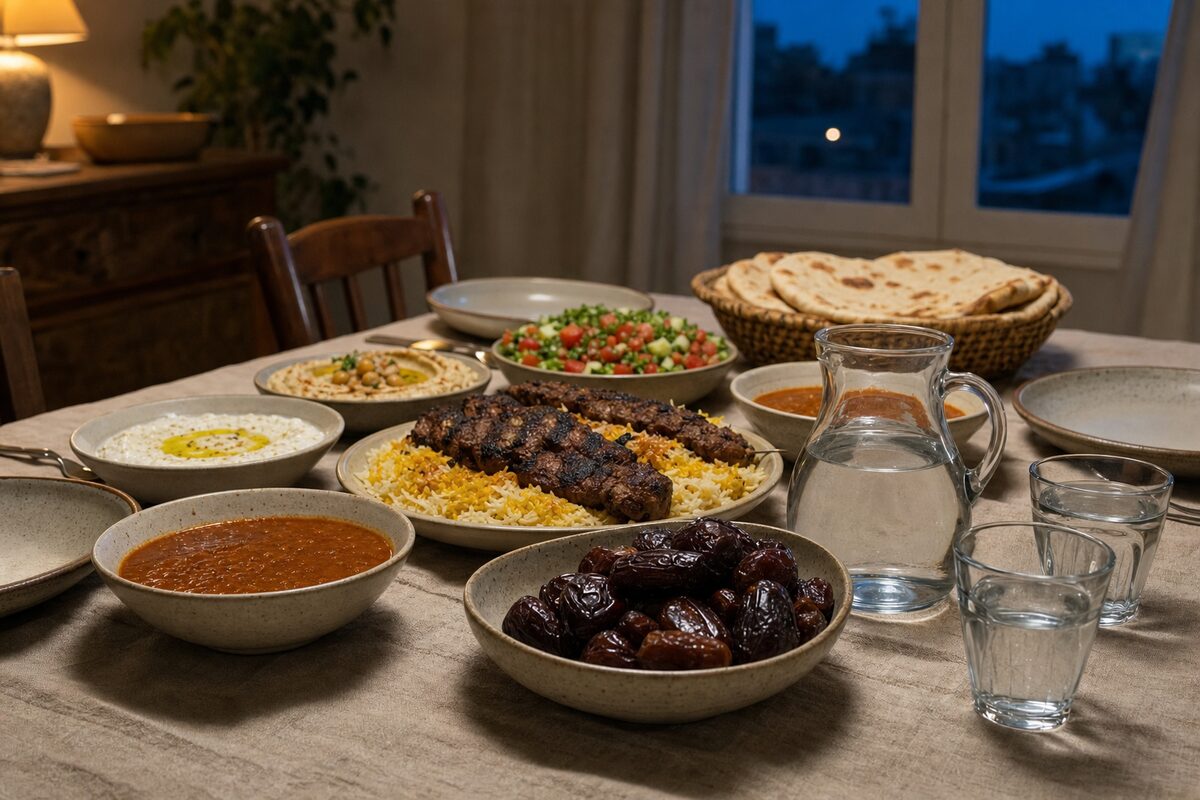
Iftar is the meal that breaks the daily fast during Ramadan, eaten the moment the sun sets. Most families open with dates and water, pray Maghrib, then come back to a shared table of soup, salads, dips, bread and something off the grill. Ordering food for iftar is less about the menu than about timing, because the meal begins at a minute nobody chooses.
This guide covers what an iftar table actually holds, how iftar differs from suhoor and from Eid al-Fitr, and the practical side of feeding a room full of people who all start eating at once.
What is iftar, and when exactly does it happen?
Iftar is the evening meal that ends the daily fast in Ramadan, and it begins at the sunset call to prayer, not at a set clock time. Ramadan is the ninth month of the Islamic lunar calendar, and fasting through it from dawn until sunset is one of the five pillars of Islam.
Because the Islamic calendar is lunar, Ramadan moves roughly ten to eleven days earlier each Gregorian year, so it drifts through the seasons over a lifetime. Ramadan 1448 is expected to start around 8 February 2027 and finish around 8 March, though the exact start and end depend on the sighting of the new crescent moon and are announced locally.
That February timing matters here. Sunset in the Fraser Valley in early February falls a little after 5 in the afternoon, and by the end of the month it is closer to 6. Compared with a Ramadan that lands in June, a February iftar is an early dinner, which changes how a gathering is planned: people come more or less straight from work, and the food has to be ready before they arrive rather than after.
Two other meals sit alongside iftar. Suhoor is the small meal taken before dawn, before the fast resumes. Taraweeh are the additional night prayers many people attend during Ramadan, which is why iftar itself is often eaten briskly rather than stretched over three hours. People who are ill, travelling, pregnant or nursing are not expected to fast.
This is a large and growing part of Canadian life. In the 2021 Census, nearly 1.8 million people in Canada identified as Muslim, about 4.9 per cent of the population, up from 2.0 per cent in 2001, with roughly 126,000 in British Columbia. For a background on the month itself, Britannica’s entry on Ramadan is a solid, neutral starting point.
What actually goes on an iftar table?
An iftar table almost always opens with dates and water, then widens into a full spread of small dishes rather than a single plated main. What fills the middle varies enormously by country, and there is no one correct iftar menu.
Across Middle Eastern homes, the shape tends to run like this:
- The opening. Dates and water, often three dates, following the practice of the Prophet Muhammad. Some families add milk, laban or a fruit drink.
- Something warm and light. Lentil soup is the near universal Levantine choice, because a hot, soft, salty bowl is kind to an empty stomach.
- Salads. Fattoush is strongly associated with Ramadan tables in the Levant. Tabouli and chopped salads sit alongside it.
- Dips and bread. Hummus, baba ganoush, muhammara and labneh with flatbread, all of them made ahead so nothing is cooking at the moment of sunset.
- The mains. Grilled meats, stews, stuffed vegetables, rice dishes. This is where families differ most from one another.
- Sweets and drinks. Qatayef, the folded pancake stuffed with cheese or walnuts, is genuinely seasonal and shows up mainly in Ramadan. Jallab and qamar al-din, an apricot drink, are Ramadan staples in Levantine homes.
Egyptian, Levantine, Somali, South Asian and Indonesian iftars all look different from each other, and a Fraser Valley mosque hall on a given evening may hold all of them at once. If you are cooking or ordering for a mixed room, the safest assumption is that people expect variety, not one national menu.
Why does an iftar table work so much like a mezze table?
Because when a whole room starts eating at the same minute, many small dishes on the table beat one dish coming out of a kitchen. The logic is the same one behind a mezze spread: everything arrives at once, in the middle, and people help themselves.
That structure solves three problems at the same time. Nobody waits while someone else is served. Guests who want to eat lightly after a long fast can start with soup and salad while others go straight for the grill. And the cold half of the table, the dips and salads, is finished hours before anyone arrives, which leaves only the hot dishes needing attention at the moment it counts.
It also handles a room with mixed dietary needs without singling anyone out. Dips and salads are already vegetarian in most Middle Eastern spreads, so a vegetarian guest builds a full plate from the same table as everyone else rather than waiting for a separate meal.
How is iftar different from suhoor and from Eid al-Fitr?
They are three different meals doing three different jobs, and the food follows the job.
| Iftar | Suhoor | Eid al-Fitr meal | |
|---|---|---|---|
| When | At sunset, daily through Ramadan | Before dawn, daily through Ramadan | The morning and day after Ramadan ends |
| Mood | Social, often with guests | Quiet, family only, half asleep | Festive, visiting, houses full |
| What the food must do | Be ready at an exact minute, ease a body back into eating | Release energy slowly through a long day | Feed waves of guests over hours |
| Typical shape | Dates, soup, salads, dips, bread, grilled mains | Eggs, yogurt, cheese, bread, dates, slow grains | Big spreads, sweets, coffee, more sweets |
| Ordering in | Common for gatherings and community iftars | Almost never | Very common |
Eid al-Fitr is the festival that ends the month. It opens with a communal morning prayer, and Zakat al-Fitr, a charitable payment, is given before that prayer. Then comes visiting: relatives, neighbours, and repeated rounds of coffee and sweets. Maamoul, the semolina cookie filled with dates or nuts, is the defining Eid sweet in the Levant, and it is also baked by Arab Christian families at Easter, which tells you something about how old and how shared the tradition is. Britannica’s entry on Eid al-Fitr covers the observance itself.
The practical difference for anyone ordering food: iftar needs punctuality, and Eid needs volume and staying power.
How do you order Middle Eastern food for an iftar gathering?
Order for the sunset, not for a clock hour, and lean on dishes that hold. That is most of it. Here is the checklist we would give anyone planning one in the Fraser Valley:
- Find your sunset time first, then work backwards. Local prayer timetables list it to the minute, and it shifts a minute or two every day through the month.
- Have the cold half on the table before guests arrive. Dips, salads and bread should be set out, not still in bags.
- Keep the hot dishes last and short. Rice holds its heat well in a covered tray. Grilled meat is best made close to serving and moved quickly.
- Plan for people eating in two waves. Some guests break the fast, pray, and come back to eat properly. Food that is fine ten minutes later is worth more than food that is perfect for ninety seconds.
- Say the guest count out loud early. Community iftars in particular tend to grow in the last week. Our guide to how much Middle Eastern food to plan per person is a useful sanity check.
- Ask your dietary questions when you book, not on the day.
We take orders and catering bookings by phone, which suits this kind of planning better than a form does. Call (819) 743-5953 with your date, your guest count and the time the sun sets, and we will shape the order around it.
What if halal matters for your guests?
Then ask directly, and expect a direct answer. We will not print a blanket halal claim on a website, because sourcing is a supply question and suppliers change.
What we can say plainly: there is no pork anywhere on our menu, and every meat dish is beef or chicken. Beyond that, call and ask about your specific order and we will tell you exactly what we can and cannot confirm at that time. If we cannot confirm what your guests require, we will say so rather than let you find out later. Our full guide to halal, vegetarian and dietary questions sets out the same position in more detail.
That is the honest version, and for a meal built on a month of discipline, honest is the only version worth giving.
Planning an iftar or Eid gathering in the Fraser Valley
An iftar order is a timing problem wearing a menu’s clothes. Build the table around dishes that are ready early, keep one hot element for the last ten minutes, and give whoever is cooking the sunset time rather than a rough hour.
Have a look at the menu to see the shape of what we cook, see which cities we cater iftar and Eid gatherings in, including Surrey, or call (819) 743-5953 to talk through a gathering. Ramadan bookings are worth making early, because everyone in the community wants the same handful of evenings.
Frequently asked questions
When is Ramadan in 2027?
Ramadan 1448 is expected to begin around 8 February 2027 and to end around 8 March, with Eid al-Fitr the following day. Those dates are not fixed in advance. The month starts and ends on the sighting of the new crescent moon, so local mosques may announce a start one day either side. Check with your own community before you book anything.
What do Muslims eat first at iftar?
Dates and water, in most households. Breaking the fast on dates follows the practice of the Prophet Muhammad, and it is gentle on a stomach that has been empty since dawn. The Maghrib prayer usually comes next, and the main meal follows a few minutes later once everyone returns to the table.
What is the difference between iftar and suhoor?
Iftar is the evening meal that breaks the fast at sunset. Suhoor is the quiet meal eaten before dawn, before the fast begins again. Iftar is social and often shared with guests. Suhoor is smaller, earlier and usually family only, built around food that will hold someone through a long day.
Is the food at Salma's Kitchen halal?
We do not print a halal claim we cannot stand behind. What we can say plainly is that there is no pork anywhere on our menu: every meat dish is beef or chicken. Sourcing is a supply question, so if halal matters for your guests, call us and ask about your specific order and we will tell you exactly what we can and cannot confirm.
What kind of food travels well for an iftar gathering?
Dips, salads, rice and grilled items in trays. Cold mezze is made ahead by design and is happy sitting on a table, rice holds its heat well in a covered tray, and grilled meats are best made last and moved quickly. Anything that depends on being crisp is the hardest thing to transport.
Do you have to be Muslim to attend an iftar?
No. Iftar is one of the most openly hospitable meals in the Middle Eastern calendar, and mosques and families across Canada invite neighbours, coworkers and friends of every background. Guests are not expected to have fasted. Arriving on time matters more than anything else, because the meal starts the minute the sun sets.
Salma’s Kitchen cooks Armenian and Middle Eastern food in Abbotsford, BC. See the menu, our catering service areas, or how to order. Phone only: (819) 743-5953.