Journal
What Makes Armenian Food Different From Other Middle Eastern Food?
Armenian food and Levantine food share a table, a mezze tradition and a great many ingredients, but they are not the same cuisine. Armenian cooking is wheat first, built on bulgur, lavash and slow grain dishes, seasoned with warm ground spices rather than raw lemon and garlic, and it has its own cured meats and its own oven. The overlap is real history, not confusion.
This guide covers what actually separates the two, which dishes are distinctly Armenian, and which ones several cultures claim at once.
What is Armenian cuisine built on?
Wheat, dairy, herbs and fire, in roughly that order. Armenian cooking comes from a highland agricultural tradition, and wheat runs through nearly all of it: as lavash, as bulgur in kofta and kibbe style dishes, as pilaf, and as the base of slow cooked porridges.
The oven matters as much as the ingredients. The tonir is a clay oven sunk into the ground, and it does two jobs: bread is baked against its walls, and meat is lowered into it on skewers. That single piece of equipment explains lavash, and it explains why Armenian grilling is so often vertical rather than laid flat over a grate.
Dairy is the third pillar. Matsun, the Armenian fermented milk, appears in Armenian texts as far back as the eleventh century and is still made by carrying a live culture forward from batch to batch rather than starting fresh each time. It turns up as a drink, a sauce, a soup base and a marinade.
Then there are the herbs. Armenian cooking draws on a very wide range of wild greens, aveluk (a wild sorrel) most famously, traditionally dried in braided ropes and rehydrated through the winter. That habit of preserving what the mountains gave you, drying, curing and fermenting, is one of the cuisine’s defining reflexes.
What makes Armenian food different from Lebanese or Syrian food?
The clearest differences are in the grain, the spicing and the cured meats. Both cuisines share the mezze table, the grill and a love of parsley, so the contrast sits in the details rather than the structure.
| Armenian cooking | Levantine cooking | |
|---|---|---|
| Signature grain | Bulgur and cracked wheat throughout | Rice more often, bulgur in specific dishes |
| Spicing | Warm and ground: allspice, cumin, paprika, coriander | Bright and raw: lemon, garlic, mint, sumac, seven spice |
| Bread | Lavash from a tonir wall | Pocket bread, markook from a saj |
| Cured meats | Central: sujuk, basturma | Present but less central |
| Dairy | Matsun in cooking, not only alongside | Labneh and yogurt, mostly alongside |
| Grilling | Khorovats, often skewered into a tonir | Mangal grilling, flat over charcoal |
| Slow dish | Harissa, wheat and meat cooked to a porridge | Stews and stuffed vegetables in sauce |
None of this is a hierarchy. It is a description of two traditions that grew up next to each other and then, for a century, inside each other.
Why is so much Armenian food also Middle Eastern?
Because the modern Armenian diaspora largely formed in the Middle East, and its kitchens formed there too. That history is the reason a phrase like “Armenian food with Middle Eastern infusion” is a factual description rather than a marketing line.
Survivors of the Armenian Genocide who reached Syria, Lebanon and Egypt built communities in Aleppo, Beirut and Cairo, and Armenian cooking there met Levantine ingredients daily for generations. Armenian butchers became known across the Levant for sujuk and basturma. Aleppo pepper entered Armenian kitchens. Mezze became the way an Armenian family in Beirut ate, and then the way their grandchildren ate in Montreal or Vancouver.
Canada is downstream of exactly that. Around 20,000 Armenians emigrated to Canada from the Middle East, mostly between 1950 and 1965, and The Canadian Encyclopedia records that most Armenian Canadians descend from genocide survivors who had settled in Syria, Lebanon and Egypt. Roughly 69,000 people reported Armenian origins in the 2021 Census.
So when an Armenian kitchen in the Fraser Valley serves hummus beside kibbe, that is not fusion invented for a menu. It is two or three generations of actual family history on a plate.
Which dishes are most distinctly Armenian?
These are the ones that read as Armenian first, wherever you meet them.
- Lavash. The thin tonir-baked bread, inscribed by UNESCO in 2014 as an expression of culture in Armenia. The baking is traditionally done by a group of women working together, and the shared labour is treated as part of the tradition itself.
- Khorovats. Armenian grilled meat, cut in large chunks, skewered, and cooked over embers or lowered into a tonir. Grape vine cuttings are prized as fuel. In Armenia itself pork is common in khorovats, which sets it apart from the cuisines of Muslim majority neighbours, while Armenian kitchens in the Levant lean to lamb, beef and chicken.
- Harissa, or keshkeg. Cracked wheat and meat stirred for hours until they become one creamy mass. Widely called the national dish. It shares nothing but a name with North African harissa paste.
- Tolma. Vegetables and vine leaves stuffed with meat and grain. Armenia’s pasuts tolma is a distinct Lenten version, made with beans and grains and no meat at all, which reflects the fasting calendar of the Armenian Apostolic Church.
- Manti. Small boat shaped dumplings, in the Armenian style baked until crisp and then served with broth and garlicky yogurt, rather than boiled soft.
- Sujuk and basturma. The two great Armenian cured meats: a spiced, firm sausage and an air dried beef coated in a paste of fenugreek, garlic and paprika. Our note on what sujuk is goes into the sausage in more detail.
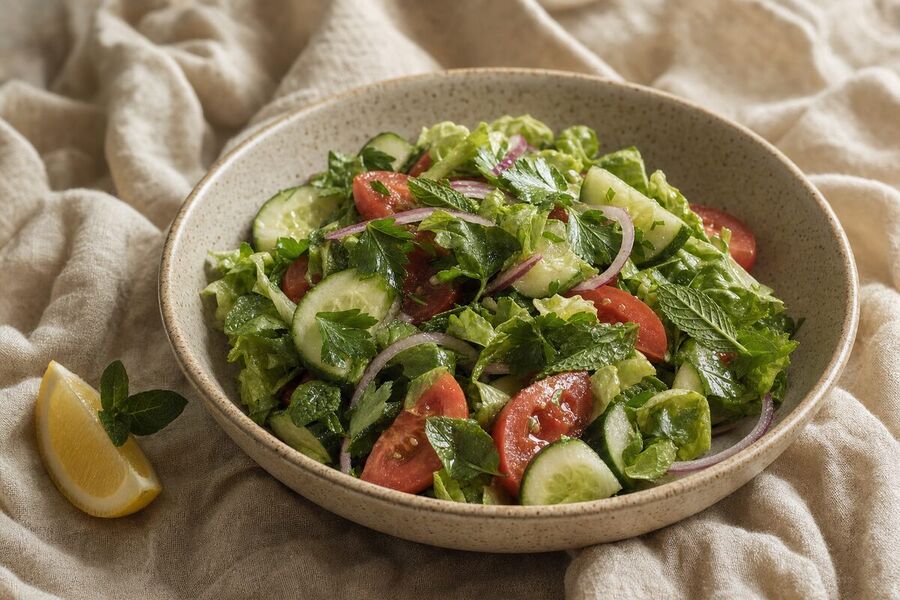
- Armenian salad. Lettuce, tomato, cucumber and red onion cut fine and even, dressed simply with lemon and olive oil. The knife work is the recipe. We compare it with tabouli and fattoush.
- Apricots. Armenia’s association with the fruit is old enough to be written into its botanical name, Prunus armeniaca, even though the apricot itself almost certainly originated further east in Central Asia or China.
Which dishes do Armenians and their neighbours both claim?
Quite a few, and pretending otherwise does nobody any favours. The Caucasus, Anatolia and the Levant have been passing dishes across the same kitchens for centuries, and the borders are much younger than the recipes.
- Lavash. UNESCO inscribed lavash for Armenia in 2014 and, separately in 2016, inscribed flatbread making and sharing culture covering lavash, katyrma, jupka and yufka in Azerbaijan, Iran, Kazakhstan, Kyrgyzstan and Türkiye. Both are on the same list.
- Harissa and keskek. The Armenian wheat and meat porridge has a direct counterpart in Anatolia, and Türkiye’s ceremonial keskek tradition was inscribed by UNESCO in 2011.
- Dolma and tolma. Armenian tolma and Azerbaijani dolma are both long standing traditions. UNESCO’s 2017 dolma inscription was submitted by Azerbaijan. Armenians have their own continuous tradition and their own name for it.
- Lahmajoun and lahmacun. The thin meat topped flatbread exists in Armenian, Turkish and Levantine kitchens, with lahm bi ajin as the Arabic cousin.
- Sujuk, sucuk, soudjouk. One sausage, many spellings, spread across Armenian, Turkish, Balkan and Arab traditions.
- Basturma and pastirma. Air dried spiced beef claimed by Armenian, Turkish and Greek traditions alike, and the ancestor of pastrami by way of Romania and New York.
Where a dish sits at a crossroads, the accurate answer is that several traditions genuinely make it. Assigning one owner is usually politics, not food history.
How does an Armenian table actually work?
Like a mezze table, with a longer lunch. Dishes come to the centre, everyone reaches in, and the meal is measured in hours rather than courses. That structure is shared with the Levant and is the part of Armenian eating that translates most easily to a Canadian dining room.
The hospitality convention is worth naming: the host keeps offering, the guest keeps being fed, and running out is close to unthinkable. It is why Armenian catering spreads tend to look generous to the point of excess. That is deliberate. Our note on the Sunday lunch tradition is the short version of the same idea.
Armenian food in the Fraser Valley
Armenian cooking is wheat, fire, cured meat and preserved greens, carried through the Levant for a century and then across an ocean. The Middle Eastern half of the story is not decoration on top of it. It is part of the history.
See what that looks like on our menu, or call (819) 743-5953 to talk about an order or a catering spread here in the Fraser Valley.
Frequently asked questions
Is Armenian food the same as Lebanese food?
No, though a century of shared history in Aleppo and Beirut brought them close. Armenian cooking leans on wheat, warm ground spices like allspice and cumin, cured meats and slow wheat dishes. Lebanese cooking leans harder on raw lemon, garlic, mint and a wider range of fresh herbs. Both share the mezze table.
What is the national dish of Armenia?
Harissa, also called keshkeg, is usually given that title. It is not the North African chilli paste of the same name. Armenian harissa is cracked wheat and meat, usually chicken or lamb, cooked and stirred for hours until the two dissolve into a thick, creamy porridge.
Why is so much Armenian food also Middle Eastern?
Because the modern Armenian diaspora largely formed in the Middle East. Survivors of the Armenian Genocide settled in Syria, Lebanon and Egypt, and Armenian kitchens there absorbed Levantine ingredients while keeping their own techniques. Most Armenian Canadians descend from those communities, which is why the two cuisines arrive together.
What is the difference between Armenian salad and tabouli?
Armenian salad is a vegetable salad: lettuce, tomato, cucumber and red onion, finely and evenly chopped, dressed with lemon and olive oil. Tabouli is a herb salad, mostly parsley, with only a small amount of bulgur. One is crisp and clean, the other is green and grassy.
Do Armenians and Turks make the same dishes?
Some, yes, and the overlap is genuine rather than a matter of one side borrowing. Lahmajoun and lahmacun, manti, sujuk and sucuk, basturma and pastirma, harissa and keskek all exist in both traditions under related names. Saying so is more honest than assigning a single owner.
What is lavash?
Lavash is a thin flatbread of flour, water and salt, baked by slapping the stretched dough onto the wall of a clay tonir oven for under a minute. UNESCO inscribed lavash as an expression of Armenian culture in 2014. Dried, it stores for weeks and revives with a sprinkle of water.
Salma’s Kitchen cooks Armenian and Middle Eastern food in Abbotsford, BC. See the menu, our catering service areas, or how to order. Phone only: (819) 743-5953.