Journal
Which Fraser Valley Summer Crops Suit Middle Eastern Food?
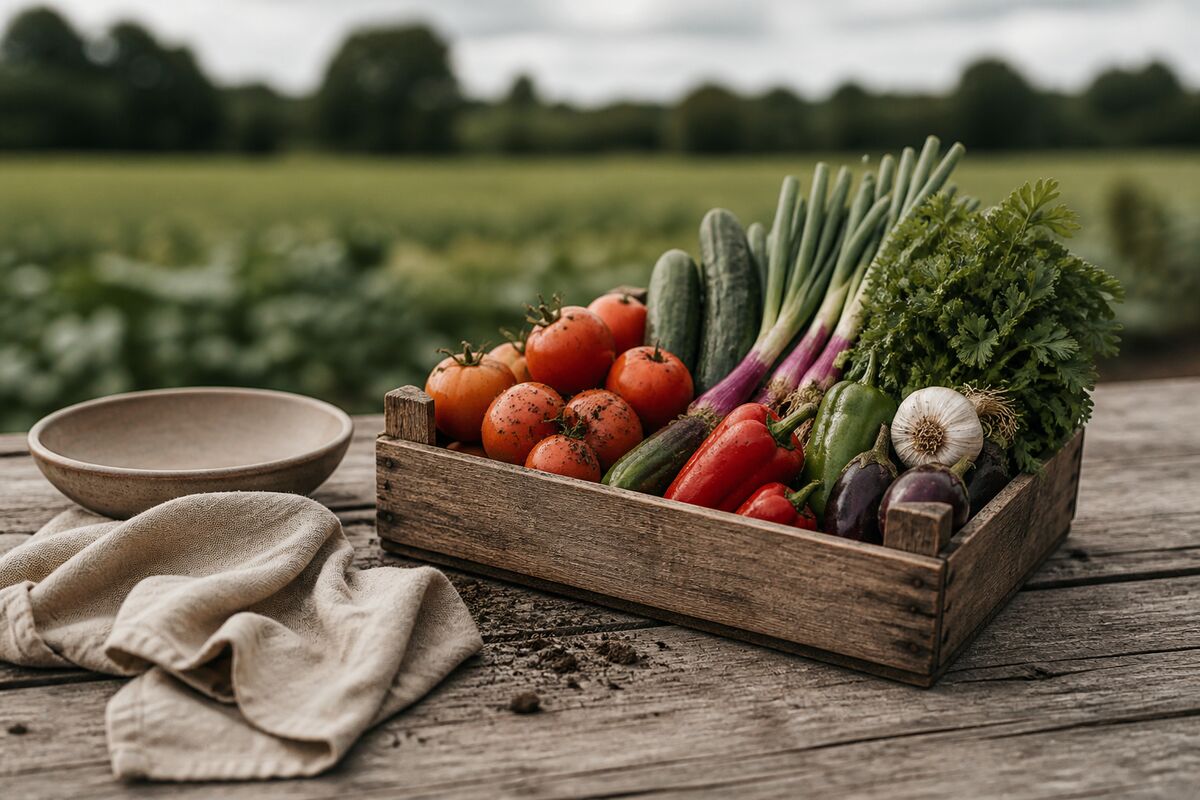
The Fraser Valley grows almost the entire summer half of a Middle Eastern kitchen. Peppers, tomatoes, cucumbers, zucchini, beans, garlic, onions and the herbs that carry a salad are all listed as in season here from June through September. The one notable gap is eggplant, which BC grows in greenhouses rather than in the field.
This is a guide to what the valley is actually producing month by month, where each crop lands in the cooking, and what changes once October arrives and the fields hand over to storage.
What is actually in season here in late summer?
August is the widest month of the year, and September is close behind. The BC Association of Farmers’ Markets keeps a month by month list for Southwest BC, the region the Fraser Valley sits in, and the August entry runs to more than forty items.
Here is the shape of the season, limited to the crops a Middle Eastern kitchen reaches for most:
| Month | Fresh in Southwest BC (selected) | Where it lands in the cooking |
|---|---|---|
| June | Cucumber, peppers, tomatoes, zucchini, summer squash, spinach, Swiss chard, garlic, strawberries | The first honest chopped salads of the year |
| July | Everything from June plus beans, corn, cherries, raspberries, currants, leeks, potatoes | Salads at their peak, peppers arriving for roasting |
| August | Peak of the year: tomatoes, peppers, cucumbers, zucchini, beans, corn, melons, blueberries, peaches, plums, shallots | Tabouli, Armenian salad, roasted pepper dips, grilled vegetables |
| September | Tomatoes, peppers, cucumbers, zucchini, beans, corn, grapes, cranberries, winter squash arrives | The last of the summer salads, first of the roasting season |
| October | Peppers, tomatoes and cucumbers waning, brassicas and roots take over, pumpkin, winter squash, kiwi | Cooking moves indoors and gets slower |
The full lists live on the association’s what’s in season page, which is the most useful single bookmark for anyone shopping the valley by calendar rather than by habit.
The swing across the year is larger than most people picture. Count the fresh entries on the Southwest BC list and August holds 43 of them. January holds eight. That is roughly a fivefold difference between the widest month and the narrowest, and it is the single most useful fact for anyone deciding when to build a meal around raw vegetables and when to stop trying.
How much of Abbotsford is actually farmland?
Almost three quarters of it. The City of Abbotsford reports that approximately 72 percent of its land sits inside the Agricultural Land Reserve, the provincial designation that protects farmland from being built on, and describes the city as one of the most intensively and diversely farmed areas in Canada.
That is not a decorative statistic. Abbotsford is the largest municipality in BC by area at 389 square kilometres, and the city counted 1,282 farms in operation in 2011 with over 7,000 people employed on them. Berries are the headline crop: Buy BC reports that British Columbia produces over 90 percent of Canada’s highbush blueberries, across 26,000 acres and more than 600 growers, primarily in the Fraser Valley.
For a kitchen, the practical consequence is proximity. The difference between a tomato that travelled twenty minutes and one that travelled two thousand kilometres is not an idea, it is a texture. Our note on why we source from Fraser Valley farms covers why our family made that a rule rather than a preference.
Which crops does Middle Eastern cooking lean on hardest?
Peppers, tomatoes, cucumbers, parsley and garlic, in roughly that order. Those five carry a disproportionate share of the cuisine, and four of the five are listed in season in Southwest BC for at least four months of the year.
- Red peppers become muhammara, the roasted pepper and walnut dip thickened with breadcrumbs and sharpened with pomegranate molasses. Our post on what muhammara is explains why it is the dip most people here have never met.
- Tomatoes and cucumbers are the backbone of the chopped salads. The differences between them are real and worth knowing, which is what our comparison of tabouli, fattoush and Armenian salad is for.
- Parsley is not a garnish in this cooking, it is a main ingredient. A proper tabouli is closer to a parsley salad with bulgur in it than the other way around.
- Garlic and onions run through the dips, the marinades and the grill. Both are on the local fresh list from June onward.
- Zucchini, beans and summer squash are the grilled vegetable season, the months when a vegetarian plate needs no apology.
The berries are the surprise. Blueberries, raspberries and blackberries are not traditional in Levantine or Armenian cooking, but the valley grows them in quantities that make them hard to ignore, and fruit alongside something rich is an old idea in this cuisine even when the specific fruit is new to it.
There is also a plain practical point about the grill. The months when zucchini, peppers and summer squash are all listed fresh are the months when a plate of grilled vegetables stops being a compromise and becomes the thing you would order anyway. Our post on vegetarian and vegan Middle Eastern food goes through which dishes are naturally meat free year round, but late summer is when that side of the menu is at its least apologetic.
What about eggplant, the one that is not on the local list?
Eggplant is the honest gap, and it is worth being straight about. Baba ganoush is built on it, and eggplant does not appear on the BC Association of Farmers’ Markets fresh list for Southwest BC in any month of the year.
What the province does say is that greenhouse vegetable crops produced in British Columbia include cucumbers, eggplant, lettuce, peppers and tomatoes. So BC eggplant exists, it simply grows under glass rather than in a Fraser Valley field, which is why you will not find it on a summer market table beside the corn.
This is the sort of thing we would rather say plainly than smooth over. A kitchen that claims everything is local is either not looking closely or not telling you the truth. Our guide to where Middle Eastern ingredients come from in the Fraser Valley goes through the pantry the same way, ingredient by ingredient.
What happens to the cooking when the season closes?
It moves indoors and gets slower, and the pantry starts doing the work the fields were doing. By December the Southwest BC fresh list is apples, beets, Brussels sprouts, cabbage, carrots, kale, kiwi, leek, onion, parsnip, pears, potatoes, rutabaga, winter squash and turnip. By January it is down to roughly eight fresh items, with the rest listed as storage, dried or frozen.
Middle Eastern cooking has an unusually good answer to that, because it was developed in places with hard seasons of their own. Bulgur, chickpeas, lentils, rice, tahini, olive oil, pomegranate molasses, sumac and dried spices are all shelf stable by design. A winter table here leans on dips, grains, roasted things and the grill rather than on raw salads, and it loses far less than you would expect.
That is also why the same menu works in February and August. The salads are better in summer, honestly. The dips, the rice and the grill do not much care.
Browse the full menu to see what that looks like in practice, and call (819) 743-5953 if you want to talk through a spread. We take orders by phone only, so you get a person rather than a form.
Frequently asked questions
What produce is in season in the Fraser Valley in August?
The BC Association of Farmers' Markets lists tomatoes, peppers, cucumbers, zucchini, summer squash, beans, corn, garlic, onions, lettuce, spinach and Swiss chard as fresh in Southwest BC in August, alongside blueberries, raspberries, blackberries, strawberries, peaches, plums and melons. August is the widest month of the year for local fresh produce.
Is Abbotsford really farmland?
Overwhelmingly. The City of Abbotsford reports that approximately 72 percent of its land sits within the Agricultural Land Reserve, the provincial zoning that protects farmland from development. The city describes itself as one of the most intensively and diversely farmed areas in Canada, and it is the largest municipality in BC by area at 389 square kilometres.
Which Middle Eastern dishes use summer vegetables the most?
Roasted red pepper dips such as muhammara, smoky eggplant dips such as baba ganoush, and the chopped salads. Tabouli leans on parsley, tomatoes, cucumbers and onions, and an Armenian salad is the same family of ingredients cut differently. All of those are at their best in the months the valley is actually growing them.
Is eggplant grown in British Columbia?
Yes, but in greenhouses rather than in the field. The province lists cucumbers, eggplant, lettuce, peppers and tomatoes as BC greenhouse vegetable crops. Eggplant does not appear on the BC Association of Farmers' Markets fresh list for Southwest BC in any month, so field grown local eggplant is not something we would claim.
What is in season in the Fraser Valley in winter?
Roots and brassicas. The Southwest BC list for December holds apples, beets, Brussels sprouts, cabbage, carrots, kale, kiwi, leek, onion, parsnip, pears, potatoes, rutabaga, winter squash and turnip. By January the fresh list shrinks to about eight items and the rest is storage, dried or frozen.
Does eating seasonally change how Middle Eastern food tastes?
It changes the salads most. A tabouli made with parsley and tomatoes at their peak is a different dish from the same recipe in February, because so little is hiding behind the lemon and olive oil. The cooked dishes and dips travel through the year more gracefully, since roasting and tahini do some of the work that ripeness does in summer.
Salma’s Kitchen cooks Armenian and Middle Eastern food in Abbotsford, BC. See the menu, our catering service areas, or how to order. Phone only: (819) 743-5953.