Journal
Middle Eastern Breads Explained: Pita, Lavash, Markook and Manakish
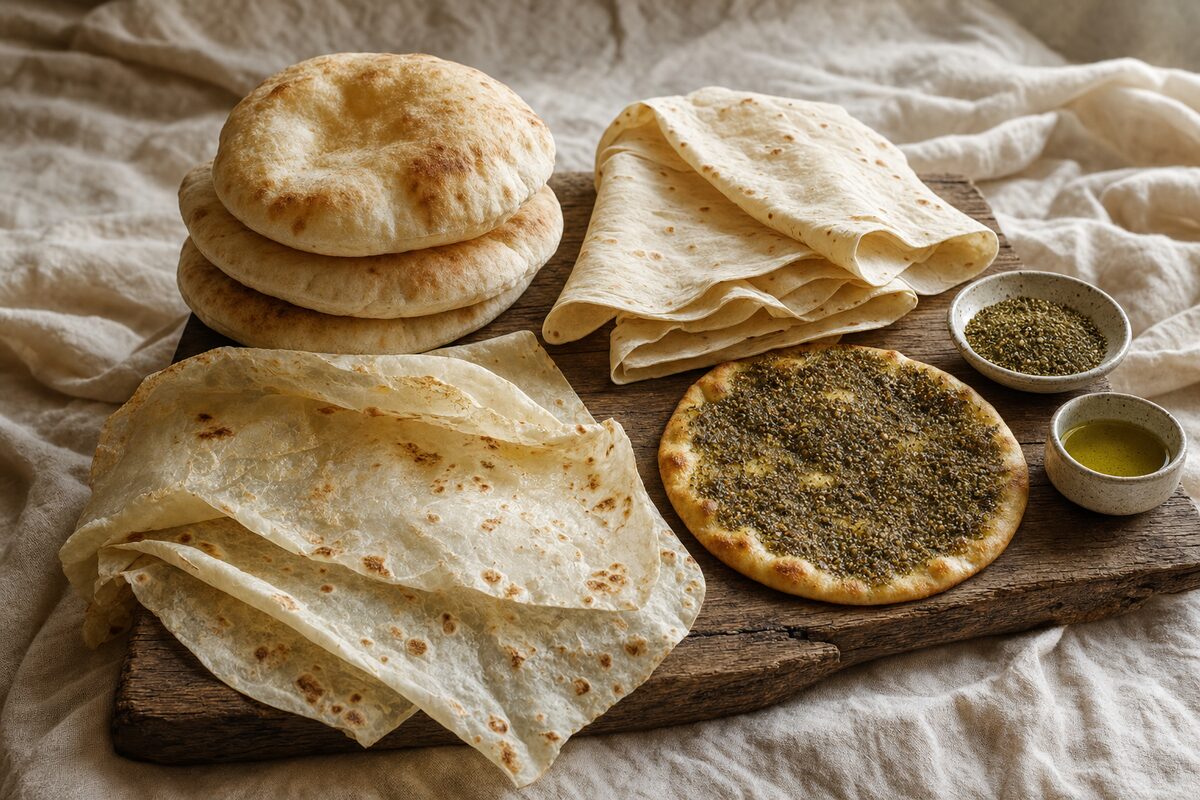
Middle Eastern flatbreads look similar from across a room and behave completely differently in your hands. Pita is leavened and puffs into a pocket. Lavash is a thin sheet baked on a clay oven wall. Markook is thinner still, cooked on a metal dome. Manakish is a flatbread with a topping baked into it. The difference is the oven, almost every time.
This guide walks through the main breads, how each one is made, and which dishes each belongs with.
What are the main Middle Eastern breads, and how do they differ?
The quickest way to tell them apart is to ask two questions: was there yeast in the dough, and what surface did it touch while it cooked.
| Bread | Also called | Cooked on | Thickness | What it does best |
|---|---|---|---|---|
| Pita | Khubz, khubz arabi | Oven floor or stone, very hot | Medium, hollow | Scooping dips, holding a filling |
| Lavash | Lawash | Wall of a clay tonir oven | Thin sheet | Wrapping, layering, keeping for weeks |
| Markook | Saj bread, shrak, khubz ruqaq | Convex metal saj dome | Paper thin | Wrapping a whole meal |
| Taboon | Taboon, laffa in some places | Hot pebbles in a taboon oven | Thick, dimpled | Soaking up sauce and juices |
| Manakish | Man’oushe (singular) | Griddle, saj or oven | Medium, topped | Breakfast and street food |
Notice that only pita really forms a pocket. That single trait is why English speakers often use “pita” as a catch-all for a whole family of breads that do not share it. In Arabic the everyday word is simply khubz, which means bread; “pita” reached English through Greek.
Why does pita puff into a pocket?
Steam does it, not skill. A stiff, well developed dough goes into a very hot oven, the water inside turns to steam faster than it can escape through the crust, and the pressure lifts the top layer away from the bottom one like a balloon.
When the bread comes out and cools, it deflates and settles, and the space where the steam was becomes the pocket. This is why home bakers who get flat, dense discs usually have an oven problem rather than a dough problem: the heat has to be fierce and immediate, which is what a bakery deck oven or a tannur gives and a gentle domestic oven does not.
Egyptian aish baladi is a close cousin, a wholemeal version that puffs the same way. The name is worth knowing: in Egyptian Arabic, aish means life. That is not poetic licence, it is the ordinary word for bread there, and it tells you how the region files bread mentally. Not a side. A given.
What is lavash, and why is it on the UNESCO heritage list?
Lavash is a thin, usually unleavened bread of flour, water and salt, rolled into a wide sheet, stretched over an oval cushion and slapped against the inside wall of a tonir, a clay oven sunk into the ground. It bakes in thirty seconds to a minute and is pulled off the wall by hand.
UNESCO inscribed lavash as an expression of culture in Armenia on the Representative List of the Intangible Cultural Heritage of Humanity in 2014, noting that the baking is usually done by a group of women working together and that the shared labour is part of the point.
Two years later UNESCO inscribed a separate element, flatbread making and sharing culture: lavash, katyrma, jupka, yufka, submitted jointly by Azerbaijan, Iran, Kazakhstan, Kyrgyzstan and Türkiye.
Both inscriptions are real, and it is worth saying plainly that lavash is claimed by more than one culture because more than one culture genuinely bakes it. The bread is older than the borders. Where a dish sits at a crossroads, the honest answer is usually “several traditions at once”, not a winner.
One practical quirk sets lavash apart from every other bread here: it dries. Left out, the sheets go brittle and can be stacked and stored for weeks or months, then brought back with a sprinkle of water and a few minutes under a cloth. That was not a trick, it was how a household got through a winter.
What is markook, and how is saj bread made?
Markook is the thinnest bread in the Levantine repertoire, cooked on a saj: a convex metal dome heated from below, so the bread drapes over the curve rather than lying flat.
The dough is stretched by hand until it is nearly translucent, often tossed and spun over the knuckles the way pizza dough is, then laid over the hot dome. It cooks in well under a minute, picking up a few dark blisters and a faint smokiness from the metal. Markook goes by several names depending on where you are: saj bread, shrak, khubz ruqaq, mashrooh.
Because it is so thin and so wide, markook is the wrapping bread. A whole meal of grilled meat, salad, pickles and sauce goes into one sheet and rolls into something you can eat standing up. Taboon, at the other end of the scale, is thick and dimpled from being baked on hot pebbles, and its job is the opposite: it sits under food and drinks up the juices, which is exactly what Palestinian musakhan asks of it.
Is manakish a bread or a meal?
It is a bread with the meal baked onto it, and in Lebanon, Syria, Jordan and Palestine it is what a great many people eat for breakfast.
A round of dough is pressed flat, dimpled with the fingertips, spread with a topping, and baked. The classic is za’atar, the wild thyme and sumac and sesame blend, loosened with a generous amount of olive oil so it soaks in rather than sitting on top. Other standards:
- Jibneh: soft white cheese, which melts into a mild, salty sheet.
- Keshek: a fermented mix of yogurt and cracked wheat, dried and ground, tangy and deeply savoury.
- Lahm bi ajin: finely minced spiced meat with tomato and onion, spread very thin. The Armenian version, lahmajoun, is a first cousin.
- Half and half: za’atar on one side, cheese on the other, folded together.
The correct way to eat one, according to more or less everybody, is folded in half and consumed on the walk home while it is still too hot.
How is bread actually used at a Middle Eastern table?
As a tool, mostly. Bread is the utensil, the plate, the scoop and the wrapper, and that shapes how a table is set.
- You tear it, you do not cut it. A piece is torn off, folded into a rough pincer, and used to pick food up.
- It sits in the middle, not beside your plate. Bread belongs to the table the way a mezze spread does, and people reach for it constantly rather than once.
- It replaces the fork for dips. A folded piece of warm bread through hummus, baba ganoush or muhammara is the intended delivery system for all three.
- It is not thrown away. Stale bread is toasted into fattoush, soaked into fatteh, or fried into salad croutons. Wasting bread is one of the few genuine taboos at the table.
- It arrives warm or it does not arrive. Reheating flatbread wrapped in a clean cloth keeps it soft; open air makes it leathery within minutes.
Which bread goes with which dish?
Match the bread to the job. Thick and pocketed for scooping, thin and wide for wrapping, dimpled for anything with sauce.
- Thick dips and mezze: a soft pocket bread, torn and used as a scoop.
- Grilled skewers: lavash or markook, wrapped around the meat straight off the fire, which is how kabab and shish tawook are eaten across the region.
- Saucy braises and roasted chicken: taboon, or any thicker bread that can absorb without disintegrating.
- Breakfast: manakish, or plain flatbread with labneh, olives and tea.
- Leftovers: yesterday’s bread, toasted, into fattoush.
If you are building a spread at home, one soft pocket bread and one thin wrapping bread covers nearly everything a Middle Eastern table asks of it.
Bread as the quiet centre of the table
Every bread here is flour, water, salt and heat. What separates them is the surface they meet: an oven wall, a metal dome, a bed of pebbles, a stone floor. That is the whole story, and it is why a bakery’s oven matters more than its recipe.
See what a full spread looks like on our menu, read about what makes Armenian food distinct, or call (819) 743-5953 to talk about an order for your table here in the Fraser Valley.
Frequently asked questions
What is the difference between pita and lavash?
Pita is leavened and oven baked, and the heat blows it up into a hollow pocket you can stuff. Lavash is a thin, usually unleavened sheet slapped onto the wall of a clay oven, and it comes out flat and pliable with no pocket at all. Pita holds a filling. Lavash wraps around one.
Is lavash Armenian or Turkish?
Both traditions are real and UNESCO has recognised both. Lavash as an expression of Armenian culture was inscribed in 2014, and a separate 2016 element covers flatbread making and sharing culture in Azerbaijan, Iran, Kazakhstan, Kyrgyzstan and Türkiye. The bread crosses borders that are much younger than it is.
What is markook bread?
Markook, also called saj bread, shrak or khubz ruqaq, is a very large, paper thin Levantine flatbread cooked in seconds on a convex metal dome called a saj. It is thinner than lavash, faintly smoky, and flexible enough to wrap a whole meal without tearing.
Is manakish a bread or a meal?
Both, honestly. Manakish is a flatbread with a topping baked onto it, most classically za'atar and olive oil, and also cheese, keshek or spiced meat. In Lebanon, Syria, Palestine and Jordan it is breakfast, street food and a light lunch, eaten folded in half and walked with.
Why does pita puff up into a pocket?
Steam. A very hot oven turns the water in the dough to steam faster than it can escape, and the pressure pushes the top and bottom layers apart into a balloon. When the bread cools, it settles back down and the gap becomes the pocket. Too cool an oven and it never lifts.
What bread goes with hummus and dips?
A soft, warm, pocket style bread is the classic partner, because you tear it and use the piece as a scoop. Thinner breads like lavash and markook work better wrapped around grilled meat than dragged through a thick dip, though plenty of people happily do both.
Salma’s Kitchen cooks Armenian and Middle Eastern food in Abbotsford, BC. See the menu, our catering service areas, or how to order. Phone only: (819) 743-5953.