Journal
Middle Eastern Desserts Explained: Baklava, Maamoul, Knafeh and Halva
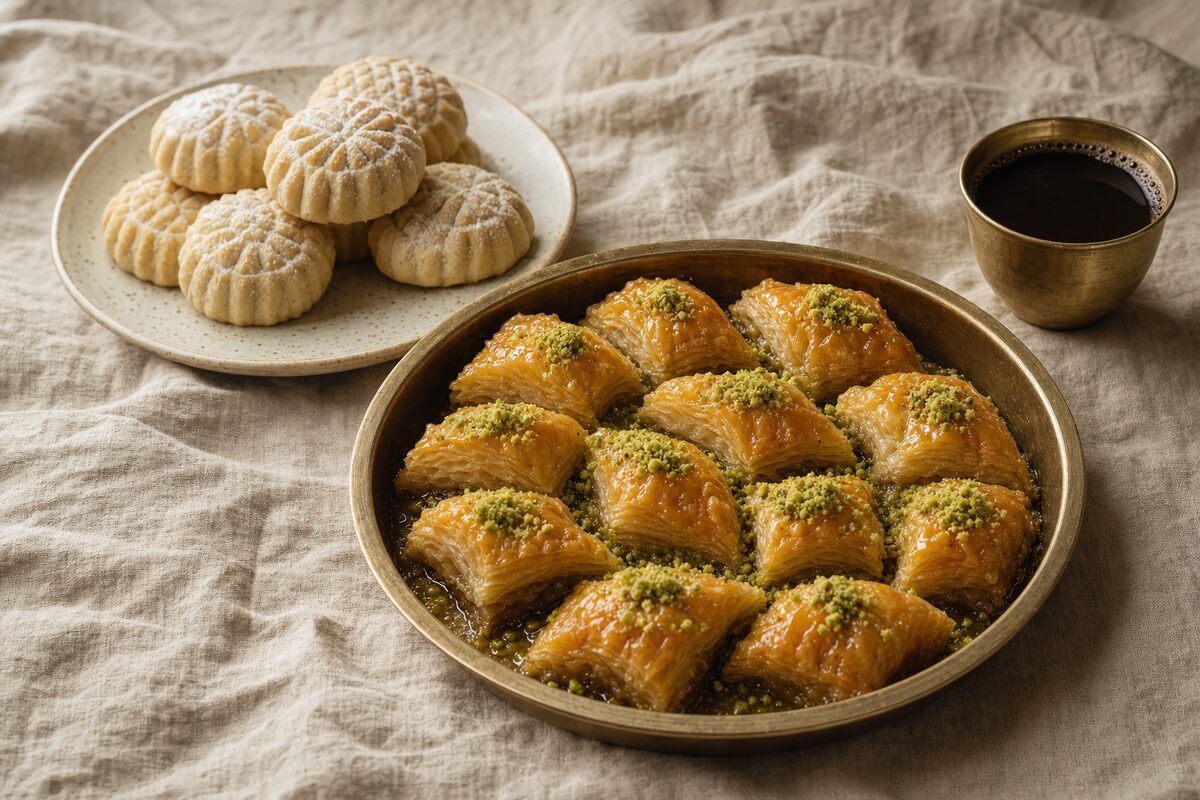
Middle Eastern desserts fall into a few clear families. Baklava is layered filo and nuts. Knafeh is shredded pastry over hot cheese. Maamoul is a moulded semolina cookie baked for holidays. Halva is either a crumbly sesame block or a soft cooked pudding. Nearly all of them meet sugar syrup at some point, and that is the thread running through the whole tradition.
This is a guide to the cuisine rather than a list of what we sell: our own menu is grilled plates, salads, dips and drinks. But these are the sweets that finish a Middle Eastern meal, and they are worth knowing.
What are the main Middle Eastern desserts?
Four names cover most of what you will meet, and they differ in the pastry, not the sugar.
| Dessert | Built from | Signature flavour | Served | Strongest association |
|---|---|---|---|---|
| Baklava | Layered filo sheets | Pistachio or walnut, butter, syrup | Room temperature | Türkiye, Greece, the Levant, Armenia |
| Knafeh | Shredded pastry or fine semolina | Melted white cheese, orange blossom | Hot, straight away | Nablus, Palestine, and Hatay, Türkiye |
| Maamoul | Semolina shortbread, moulded | Dates, walnuts or pistachios | Room temperature, with coffee | The Levant, at Eid and Easter |
| Halva | Tahini, or cooked flour/semolina | Sesame, or butter and cinnamon | Sliced, or warm by the spoon | From the Balkans to South Asia |
| Basbousa | Semolina cake | Coconut, syrup, sometimes yogurt | Cut into diamonds | Egypt and the Levant |
| Qatayef | Folded pancake, stuffed | Walnut or sweet cheese | Fried or baked, in Ramadan | The Levant, seasonally |
If you remember one distinction, make it this: baklava and maamoul keep, and knafeh does not. Knafeh is a dessert with a deadline.
What is baklava, and where did it actually come from?
Baklava is sheets of paper thin filo brushed with butter, layered dozens deep around chopped nuts, baked, then flooded with syrup while the temperature difference is still working in its favour. The result should shatter, not bend.
Its origin is genuinely disputed, and anyone who tells you otherwise is picking a side. Layered pastries with nuts show up in ancient Assyrian, Byzantine and Central Asian traditions, and the version most of us recognise was developed and formalised in the Ottoman imperial kitchens at Topkapi Palace, where baklava makers held their own rank in the kitchen hierarchy. From there it spread through every territory the empire touched, which is precisely why Greek, Turkish, Armenian, Levantine and Balkan families all make baklava that tastes like home to them.
One Ottoman custom is worth knowing because it links baklava to Ramadan: the Baklava Alayi, a ceremonial procession in which the sultan sent trays of baklava to the Janissary regiments on the fifteenth day of Ramadan.
The most formal recognition of a regional style came in December 2013, when Antep Baklavasi from Gaziantep in southeastern Türkiye became the first Turkish product entered in the EU register of protected geographical indications under Commission Implementing Regulation (EU) No 1399/2013. That protects a named regional style made with Antep pistachios and local butter. It does not settle who invented baklava, and it was never meant to.
Regional differences you can actually taste:
- Nuts: pistachio in Gaziantep and Aleppo, walnut across Greece and the Balkans, sometimes almond or cashew further south.
- Syrup: honey heavy in the Greek tradition, sugar syrup in most Turkish and Levantine versions.
- Perfume: rose water and orange blossom are common in Levantine baklava and largely absent from Gaziantep, where the pistachio is meant to carry it alone.
What is knafeh, and why is Nablus famous for it?
Knafeh is a hot dessert of shredded pastry or fine semolina laid over mild white cheese, baked until the base turns deep gold, then soaked in syrup and served immediately, ideally with the cheese still stretching.
Nablus, in the West Bank, is the city most associated with it, to the point that knafeh nabulsieh is a style name rather than a location. Nablus makers hold a Guinness World Record set in the summer of 2009 for the world’s largest knafeh, a tray measuring roughly 75 metres, as National Geographic reported in its search for the best version.
There is a second serious claim. The Levantine Arab communities of Hatay in southern Türkiye have their own long tradition of kunefe, and most food historians treat Nablus and Hatay as the two strongest claims rather than crowning one. Earlier traces point variously to Umayyad Damascus, where it is said to have been eaten as a filling pre dawn meal, and to medieval Egypt. The honest summary is that knafeh is old, Levantine, and shared.
Two styles you will see on a menu:
- Khishneh: coarse, shredded pastry on top, giving a crisp, straw like crust.
- Na’ameh: fine semolina, giving a smooth, dense, almost cake like top.
What is maamoul, and why is it baked for both Eid and Easter?
Maamoul is a semolina shortbread wrapped around a filling of dates, walnuts or pistachios and pressed into a carved wooden mould, called a tabe, that stamps a pattern into the top. It is dry, buttery, barely sweet in the dough, and made in enormous batches.
It is baked for Eid al-Fitr at the end of Ramadan, for Eid al-Adha, and by Arab Christian families for Easter, and this is not a coincidence or a borrowing in one direction. Filled holiday cookies of this shape run back through the medieval Egyptian kahk to ancient Mesopotamia, and the modern maamoul took its familiar form under Ottoman rule in the Levant. The Smithsonian’s history of maamoul traces that shared lineage, and it is one of the clearest examples in the region of a food belonging to several communities at once.
The moulds do quiet work. Many families use a different shape for each filling so that a mixed platter can be read at a glance, though which shape means which filling varies from household to household rather than following one rule. Some Christian families also read the shapes symbolically at Easter. Both things can be true.
What is halva, and why does the word mean two different things?
Because the word is a category, not a recipe. Halva comes from the Arabic root for sweet, and it has been applied for centuries to almost any sweet, dense confection. Recipes appear in Arabic cookery manuscripts by the medieval period, and the name travelled with trade all the way to India and the Balkans.
Two families dominate:
- Sesame halva. Tahini beaten into hot sugar syrup, set into a firm block that fractures into fibrous strands when you cut it. This is the halva sold in slabs, sometimes marbled with cocoa or studded with pistachio.
- Cooked halva. Semolina or flour toasted in butter or oil, then hydrated with hot syrup or milk into something soft, warm and spoonable. Greek semolina halva and Persian halva both belong here, as do many South Asian versions.
They share a name and almost nothing else. If a recipe calls for halva, find out which one it means before you shop.
Why is nearly everything soaked in syrup?
Because syrup started as preservation and stayed for pleasure. Sugar syrup, called attar or qatr, keeps a pastry edible for days in a warm climate, and it also carries the aromatics that define the region’s sweets.
The technique rule that separates good syrup pastry from soggy syrup pastry is temperature contrast:
- Hot pastry, cold syrup, or cold pastry and hot syrup. Never both hot, or the layers collapse and go heavy.
- Lemon juice in the syrup stops the sugar crystallising and cuts the sweetness enough to keep it drinkable.
- Orange blossom or rose water goes in at the end, off the heat, because the perfume boils away.
That is also why portions are small. A piece of baklava is two or three bites, taken with something bitter beside it.
How are Middle Eastern sweets actually eaten?
Rarely as a plated dessert course, and almost always with a drink that fights back. Sweets come out with coffee or tea when guests arrive, in the afternoon, after a long meal has been cleared, and above all at holidays.
The pattern looks like this:
- Hospitality first. A tray of sweets and coffee appears for visitors whether or not anyone has asked. Refusing outright is awkward; taking one piece is the move.
- Holidays in bulk. Maamoul before Eid and Easter, qatayef through Ramadan, baklava for weddings and births.
- Bitter alongside sweet. Unsweetened cardamom coffee or strong black tea, because the sugar needs an opponent. Our guide to what we pour covers the cold end of the same idea.
- Shared, like everything else. Sweets land in the centre of the table, the same way a mezze spread does.
The end of a Middle Eastern meal
Baklava for the layers, knafeh for the ten minutes it is perfect, maamoul for the holidays, halva for the pantry. Between them they cover the sweet half of a cuisine that mostly runs savoury, and the syrup is the connective tissue.
If you are planning a meal around all of this, see the savoury half on our menu, check where we cater, read about what an iftar or Eid table looks like, or call (819) 743-5953 to talk through an order for your gathering.
Frequently asked questions
What is the difference between baklava and knafeh?
Baklava is built from sheets of paper thin filo layered with chopped nuts, baked, then drenched in syrup, and it is eaten at room temperature. Knafeh uses shredded pastry or fine semolina over melted cheese, is soaked in syrup, and is meant to be eaten hot, within minutes, while the cheese still pulls.
Where does baklava come from?
Its origin is genuinely contested. Layered nut pastries appear in ancient Assyrian, Byzantine and Central Asian traditions, and the form we recognise today was refined in the Ottoman imperial kitchens at Topkapi Palace. Greek, Turkish, Levantine, Armenian and Balkan communities all have long standing claims, and all of them are making real baklava.
What is maamoul?
Maamoul is a semolina shortbread stuffed with dates, walnuts or pistachios and pressed in a carved wooden mould before baking. It is the defining holiday cookie of the Levant, baked in large batches for Eid al-Fitr, Eid al-Adha and Easter, and given away to neighbours and guests.
Is halva a candy or a pudding?
Both, depending on which halva you mean. Sesame halva is a firm, crumbly block made from tahini and sugar, sliced like fudge. Flour or semolina halva is cooked on the stove into something soft and spoonable. The Arabic root simply means sweet, so the word covers a very wide family.
Why are Middle Eastern desserts so sweet?
Because sugar syrup is the preserving agent as well as the flavour. Before refrigeration, syrup soaked pastries kept for days in a warm climate. The portions are also small by design: a piece of baklava is two or three bites, taken with bitter coffee or tea that cuts straight through the sugar.
What do you drink with Middle Eastern sweets?
Something bitter or tart, almost always. Unsweetened Arabic coffee with cardamom, strong black tea, or a sharp cold drink. The pairing is deliberate: the sweets are intense and the drink is there to reset the palate between bites rather than to add to the sugar.
Salma’s Kitchen cooks Armenian and Middle Eastern food in Abbotsford, BC. See the menu, our catering service areas, or how to order. Phone only: (819) 743-5953.