Journal
What Is Middle Eastern Food, and Where Is It in Abbotsford?
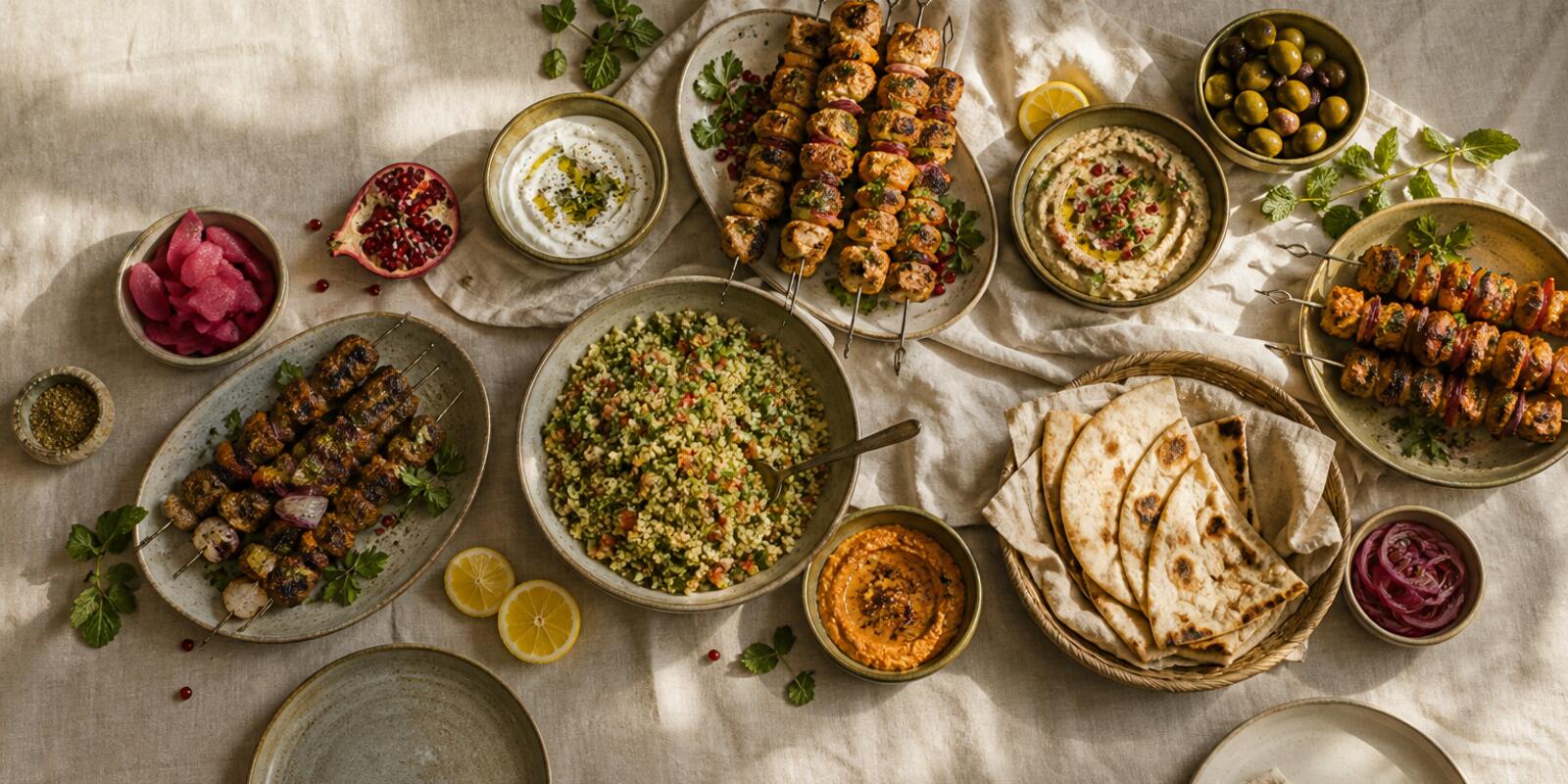
Middle Eastern food is a family of related cuisines from the eastern Mediterranean and the wider region, built on grilled meats, a shared table of small dishes called mezze, and a pantry of chickpeas, tahini, bulgur, lemon and garlic. In Abbotsford it comes mostly from small family kitchens rather than chains, which is why it takes a little finding.
Below: what the cuisine actually is, how it differs from the Greek and Turkish cooking people often confuse it with, and what a plate of it looks like here in the Fraser Valley.
What counts as Middle Eastern food?
Think of a pantry rather than a country. Middle Eastern cooking spans Lebanon, Syria, Palestine, Jordan, Iraq, Iran, Turkey and the Gulf, plus the Armenian and Kurdish communities woven through all of them, and what holds it together is a shared set of ingredients and a shared way of putting food on a table.
The pantry: chickpeas, lentils, bulgur wheat, tahini, olive oil, lemon, garlic, parsley and mint, pomegranate molasses, sumac, cumin, paprika, eggplant and roasted red peppers. The method: things come off a grill, dips get scooped with bread, salads are chopped fine and dressed with lemon rather than cream.
The habit is the real signature. Food arrives in the middle of the table for everyone to reach into, not plated per person. Canada’s food guide makes the same point from a health angle when it notes that eating meals with others is a part of healthy eating and a way to share food traditions across generations and cultures. This cuisine was built that way from the start. Our guide to what mezze is and how to order it covers how the spread is assembled.
How is it different from Greek or Turkish food?
They are cousins, not competitors, and the differences are in the seasoning rather than the structure. All three grill meat over fire, all three serve small plates, all three love yogurt, lemon and flatbread. What changes is which flavours do the heavy lifting.
| Middle Eastern and Armenian | Greek | Turkish | |
|---|---|---|---|
| Signature flavours | Tahini, sumac, cumin, pomegranate molasses, parsley | Oregano, dill, olive oil, lemon, feta | Pepper paste, cumin, mint, butter, yogurt |
| Typical dips | Hummus, baba ganoush, muhammara | Tzatziki, taramasalata, fava | Haydari, ezme, cacık |
| Grain of choice | Bulgur wheat and rice | Orzo, potatoes, rice | Bulgur and rice |
| The grill | Kabab, shish tawook, kofta | Souvlaki, gyro | Kebap in many regional forms |
| Salad style | Herb heavy, finely chopped, lemon dressed | Chunky, feta and olives | Chopped and often peppery |
| How it reaches the table | Mezze, everything at once | Small plates, then mains | Meze, then the grill |
Bread makes the point better than any list. UNESCO inscribed flatbread making and sharing culture on its heritage list in 2016 as a single tradition submitted jointly by Azerbaijan, Iran, Kazakhstan, Kyrgyzstan and Türkiye, describing bread shared at weddings, births and funerals as an expression of hospitality and common cultural roots. Five countries, one tradition. That is the region in miniature.
Why does an Armenian family cook Middle Eastern food?
Because that is where Armenian families lived. Armenian communities have been part of Syria, Lebanon and Turkey for generations, so Armenian home cooking kept its own dishes while absorbing the pantry around it.
Our family is Armenian, our story runs through Syria, and we now cook in Abbotsford. That is the whole explanation for a menu that puts an Armenian spiced sausage next to a Syrian grilled sandwich and a Levantine dip made from roasted red peppers. It is not fusion in the restaurant sense. It is simply what a household ate. The longer version of how those two labels ended up on one menu is our family’s story, from Syria to the Fraser Valley.
What does a Middle Eastern meal in Abbotsford actually look like?
Concretely: something cold to scoop, something green, something off the grill, and rice or bread underneath it. That is the shape, whether it is dinner for two or a table of twenty.
- The dips. Hummus, baba ganoush and muhammara, made from scratch. We compare all three in how to tell the dips apart.
- The salads. Tabouli, which is mostly parsley, and Armenian salad, which is a fine even chop of lettuce, tomato, cucumber and red onion in lemon and olive oil.
- The grill. Kabab, shish tawook, toshka, sujuk, a grilled vegetable plate, and our signature kibbe. Every grill dish comes as a sandwich or as a full meal with fragrant rice, salad and a dip.
- The drinks. Ayran, hibiscus tea and lemonada, which are worth trying precisely because most people have never had them.
Note what is not on that list: no single centrepiece protein that the whole meal is organised around. That absence is why the cuisine handles mixed tables so well, vegetarians included.
Is Middle Eastern food spicy or heavy?
Well spiced rather than hot, and lighter than most people expect. The flavour comes from cumin, sumac, paprika, garlic, lemon and herbs. Chilli heat is present in some dishes and absent from most.
On our menu the sujuk is the deliberately spicy one, a beef sausage with a real kick. Kabab and shish tawook are aromatic and smoky rather than fiery. The salads and dips are bright and lemony. If someone at your table is heat averse, they will be fine, and if someone wants heat, order the sujuk.
Heaviness is a similar misconception. A plate here is grilled meat, rice, a fresh salad and a scoop of dip made from chickpeas or eggplant. Canada’s food guide asks people to choose protein foods that come from plants every day, which a mezze table does without trying, since so much of it is legumes, vegetables and herbs.
Where do you find it in the Fraser Valley?
Mostly in small kitchens that do not advertise much, which is the honest answer. This is food that travels through phone calls and neighbours rather than through app listings, so the search results rarely tell the whole story in Abbotsford, Mission, Chilliwack, Langley or Aldergrove.
There is a demographic reason the supply stays small and personal. Statistics Canada’s 2021 Census counted about 690,000 people of Arab origin and 360,000 of West Asian origin in the whole country, 1.9% and 1.0% of the population, most of them concentrated in the largest cities. Outside those cities this cuisine tends to arrive one family at a time, which is exactly how it arrived here. If you would rather stock your own kitchen, we also wrote about where to buy Middle Eastern ingredients in the Fraser Valley.
We cook Armenian food with a Middle Eastern infusion in Abbotsford, for pickup here and for catering across the Fraser Valley and into Metro Vancouver, Abbotsford most of all. Have a look at the full menu, then call (819) 743-5953. We take orders by phone, which means you talk to our family rather than a form.
Frequently asked questions
What is Middle Eastern food?
It is a family of related cuisines from the eastern Mediterranean and the wider region, built on grilled meats, a shared table of small dishes called mezze, and a pantry of chickpeas, tahini, bulgur, lemon, garlic, olive oil, parsley and warm spices. The defining feature is not one dish, it is the shared spread.
How is Middle Eastern food different from Greek food?
They are close cousins with different accents. Greek cooking leans on olive oil, oregano, lemon and feta. Middle Eastern cooking leans on tahini, sumac, bulgur, pomegranate molasses and a wider spice cabinet. You will meet grilled skewers, yogurt and flatbread on both tables, seasoned two different ways.
Is Middle Eastern food the same as Turkish food?
No, though they overlap heavily and always have. Turkish cooking shares the grill tradition and the small plates habit, while Levantine and Armenian cooking put more weight on tahini dips, herb heavy salads and bulgur. Borders moved a great deal in this region and the recipes moved with the families.
Is Middle Eastern food spicy?
Usually well spiced rather than hot. The flavour comes from cumin, sumac, paprika, garlic, lemon and herbs rather than from chilli heat. Some dishes are deliberately fiery, our sujuk sausage among them, but a standard plate of kabab or shish tawook is aromatic, not burning.
What is Armenian food doing on a Middle Eastern menu?
Because Armenian communities have lived across Syria, Lebanon and Turkey for generations, so Armenian home cooking absorbed the pantry around it while keeping its own dishes. Our family is Armenian by way of Syria, which is why our menu reads as Armenian food with a Middle Eastern infusion.
Where do you find Middle Eastern food in Abbotsford?
Look beyond the mall food court. Much of it comes from small family kitchens and grocery counters that take orders by phone rather than through an app, so a call is often the fastest route. Salma's Kitchen cooks Armenian and Middle Eastern food in Abbotsford for pickup and catering across the Fraser Valley.
Salma’s Kitchen cooks Armenian and Middle Eastern food in Abbotsford, BC. See the menu, our catering service areas, or how to order. Phone only: (819) 743-5953.