Journal
Falafel or Kibbe: What Is in Each and Which to Order
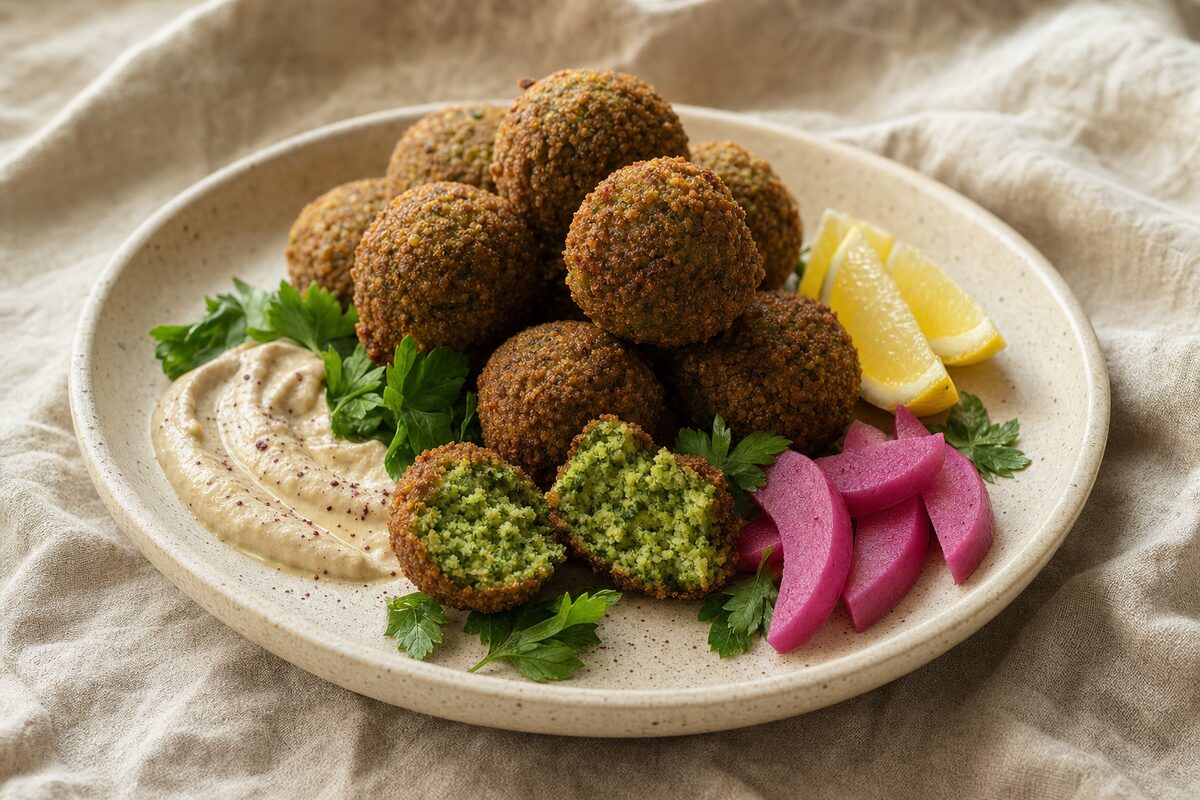
Falafel is a deep fried fritter of ground chickpeas or fava beans with herbs, garlic and spices, and it has no meat in it. Kibbe is ground beef or lamb worked together with bulgur wheat, onion and spices, then shaped and fried or baked. Same golden crust, same rough size, completely different dish.
Below is what goes into each, where each one comes from, and which to order first. One note before we start: kibbe is on our menu and falafel is not, so treat this as a guide to the cuisine rather than a list of what we sell.
What is the difference between falafel and kibbe?
The base ingredient decides everything else. Falafel starts with a legume, kibbe starts with meat and wheat, and from there the texture, the diet it suits and the occasion all diverge.
| Falafel | Kibbe | |
|---|---|---|
| Main ingredient | Ground chickpeas, fava beans, or both | Finely ground beef or lamb with bulgur wheat |
| Contains meat | No | Yes, in the classic version |
| Contains wheat | Not traditionally, though some recipes add a binder | Yes, bulgur is structural |
| Flavour | Herby and green: parsley, coriander, cumin, garlic | Savoury and warmly spiced, deeply meaty |
| Texture | Crisp shell, light and crumbly inside | Golden crust, dense and tender inside |
| Shape | Small balls or flattened patties | Torpedo or oval, or baked flat in a tray and cut into diamonds |
| How it is cooked | Deep fried | Fried, baked, grilled, and in one Levantine version eaten raw |
| Usually eaten as | Street food, wrapped in bread on the go | A sit down meal, or a tray brought to a table |
| Suits vegans | Yes | No |
If you remember one thing: falafel is what you eat walking, kibbe is what you eat sitting down with your family. That difference in occasion is at least as real as the difference in ingredients.
What is falafel made of, and why does it change country to country?
Ground legumes, fresh herbs, onion, garlic and spices, deep fried. Which legume depends entirely on where you are, and that single variable is the heart of the whole falafel argument.
In Egypt it is made with fava beans and called ta’amiya. Across most of the Levant it is made with chickpeas. And in Lebanon, notably, it is often made with both: The Canadian Encyclopedia’s guide to popular Lebanese dishes in Canada describes Lebanese falafel as chickpeas and fava beans ground together with parsley, cilantro, onion, garlic and spices, shaped into medallions and deep fried, then served with tomato, pickled turnip, parsley and tahini sauce in pita.
So the neat “Egypt uses fava, the Levant uses chickpeas” line is a useful rule of thumb that falls apart the moment you look closely, which is a good warning about food history generally.
What stays constant is the method. The mixture is never cooked before frying, which is why real falafel is made from soaked raw legumes rather than tinned cooked ones. Cooked chickpeas turn to paste and the fritters fall apart in the oil. This is the detail most home attempts get wrong.
Where does falafel actually come from?
Nobody can settle it, and the honest answer is that several traditions have a real claim. This is not diplomatic hedging. It is what the evidence supports.
Arab News, reporting on the feud over falafel, notes that falafel is claimed as a national dish by almost every people in the Middle East, and that the first known appearance of the word is in Egypt after the British occupation of 1882, which makes the dish far younger than the “food of the pharaohs” story suggests. One theory holds that British officers, missing the fried vegetable croquettes they had eaten in India, asked Egyptian cooks in Alexandria for something similar. Another credits Coptic Christians making meat free patties during Lent.
The counter-claims are just as serious. Analysts writing for AGBI list claims from Lebanon, Palestine, Israel, Syria, Türkiye and Greece, and the argument has spilled well past the kitchen: in 2010 Lebanon set a record for the largest serving of falafel, weighing 5,173 kilograms, in a contest of national pride as much as cooking.
The most useful position we have read comes from the food writer Nawal Nasrallah, quoted by Arab News, who accepts that a credible claim can be made for Egypt but adds that she does not believe a dish like falafel can be claimed by an individual country, and that the entire region may credibly be called its home. We think that is right, and it is the same position we take on dishes that Armenians and their neighbours both claim.
What is kibbe made of, and how many forms does it take?
Finely ground beef or lamb, bulgur wheat, grated onion and spices, worked together until the mixture holds its shape. The bulgur is not filler. It is what gives kibbe the texture that separates it from a meatball.
The Canadian Encyclopedia describes kibbeh as an oval meatball that is deep fried, or baked in a circular dish and scored into a diamond pattern before cooking. Pine nuts belong in the traditional filling, though they are costly enough in Canada that many kitchens use them as decoration rather than through the mixture.
The forms it takes are worth knowing, because “kibbe” on a menu can mean several quite different things:
- The fried torpedo. A shell of meat and bulgur wrapped around a filling of spiced meat and onion, then deep fried. This is the shape most people picture.
- Kibbe bil sanieh, the tray. Layered flat in a round pan, scored into diamonds and baked. The version families make when they are feeding a crowd.
- Kibbe nayyeh, raw. A Levantine specialty of very fresh raw meat pounded with bulgur, served with olive oil and mint. Ours is cooked, not raw.
- Grilled kibbe. Shaped onto skewers and cooked over coals.
- Meat free versions. Made with pumpkin, potato or lentils instead of meat, common during fasting seasons.
Our longer note on kibbe covers how ours is made and why it is the dish we are known for.
Who does kibbe belong to?
Several kitchens at once, and it has for a very long time. Kibbe is widely called a national dish of both Lebanon and Syria, it is central to Armenian cooking, and it appears across Iraq, Palestine, Jordan and southern Türkiye under related names. The word comes from the Arabic for ball, describing the shape.
This is less politically heated than the falafel argument, but the structure is the same: a technique of pounding grain and meat together, spread across a region that grew wheat and raised sheep for thousands of years, then developed into local specialities. Aleppo alone is famous for a long list of kibbeh varieties. Assigning one owner would flatten all of that.
Canada has a real stake in this history too. The Canadian Encyclopedia records that Canada’s Lebanese diaspora numbered 210,605 people in 2021, the country’s largest Middle Eastern or Southwest Asian population group, and that those families brought their cooking with them into restaurants, bakeries and grocery stores across the country. Armenian and Syrian families did the same. The dishes arrived here through people, not through trends.
Which one should you order?
Start with what you want the meal to be.
- Order falafel if you want something vegan, fast and herby, or if you are feeding a mixed table where at least one person does not eat meat. It is one of the great plant based street foods anywhere in the world. Our note on vegetarian and vegan Middle Eastern food covers the wider picture.
- Order kibbe if you want the meal that a Levantine or Armenian household is proudest of. It takes real work to make properly, it is the dish that tells you what a kitchen is capable of, and it is filling in a way falafel is not.
- Order both if you can. They sit well beside each other precisely because one is light and green tasting and the other is dense and savoury, and both want the same accompaniments: bread, a lemony salad and a dip.
Either way, add hummus. The three dips compared explains what separates hummus, baba ganoush and muhammara if you are choosing.
What we make, and what we do not
Kibbe is our signature. It comes as a meal, four pieces with fragrant rice, a fresh salad and your choice of hummus, baba ganoush or muhammara. Falafel is not something we make, and we would rather say so plainly than let a blog post imply otherwise.
Have a look at the full menu, or call (819) 743-5953 to order kibbe for pickup here in Abbotsford.
Frequently asked questions
What is the difference between falafel and kibbe?
Falafel is a deep fried fritter of ground chickpeas or fava beans with herbs, garlic and spices, and it contains no meat at all. Kibbe is ground beef or lamb worked together with bulgur wheat, onion and spices, then shaped and fried or baked. One is a vegan street food, the other is a family meat dish.
Is falafel vegan?
Traditionally yes. Falafel is built from legumes, herbs, onion, garlic and spices with no meat, dairy or egg, which is why it became a fixture of Lent and of fasting seasons across the region. Sauces are the thing to check, since tahini sauce is plant based but some shops add yogurt.
Is kibbe vegetarian?
The classic version is not. Kibbe is built on ground meat mixed with bulgur wheat, and at Salma's Kitchen ours is made with finely ground beef. Meat free versions of the same idea do exist in the region, made with pumpkin or potato instead of meat, but they are a different dish rather than a substitution.
Where does falafel come from?
Genuinely contested. Several food historians point to Egypt, where it is made with fava beans and called ta'amiya, and note that the word only appears in Egyptian writing after the British occupation of 1882. Lebanon, Palestine, Syria, Israel and others all claim it too, and the food writer Nawal Nasrallah has argued the whole region can credibly be called its home.
Does falafel contain gluten?
Traditional falafel is made from ground legumes rather than flour, so the mixture itself contains no wheat. That said, some kitchens add flour or breadcrumbs as a binder and many fry falafel in shared oil, so anyone avoiding gluten should ask about the specific recipe and the fryer rather than assume.
Can I get falafel at Salma's Kitchen?
No. Falafel is not on our menu. Kibbe is, and it is our signature dish: four pieces with fragrant rice, salad and your choice of hummus, baba ganoush or muhammara. This post is a guide to two dishes people often confuse, not a list of what we sell.
Salma’s Kitchen cooks Armenian and Middle Eastern food in Abbotsford, BC. See the menu, our catering service areas, or how to order. Phone only: (819) 743-5953.